
-
AuthorSearch Results
-
Jul 23, 2025 at 9:32am #221717
In reply to: [SOLVED] Bad resolution bug
 RalfKeymaster
Sounds as if the game switches back to a lower res, which would be super weird. Never heard of anything like that before. Try to add a custom res in the nVidia control panel and then switch your desktop res to that res before launching the game. Some games limit their resolution to the current desktop res. A step-by-step guide for adding custom resolutins can be found in the vorpX help.
Running a game windowed may also help (again provided it doesn’t limit its window size to the desktop res).
If you want to use the full potential of your new Pimax headset you must run games at resolutions at or above 4K, i.e. 2160p or more. Roughly 3000p is what your Pimax Super wants as an input res with default SteamVR settings. Might be too much performance wise in modern games though.
If things still look pixelated when running a game at such high resolutions, there has to be something weird going on after vorpX sends the image to SteamVR, e.g. in the Pimax app or on the headset itself.
Jul 22, 2025 at 9:48am #221701In reply to: [SOLVED] Bad resolution bug
RalfKeymasterPlease make sure to reset any SteamVR settings to default, same with the Pimax software. In the last “low resolution” post here in the end it turned out that the OP wasn’t able to go beyond 3000p. Even if you want to call that an issue, it’s probably a lot more than you are running your desktop with. So there has to be something else going on with your setup. vorpX captures the desktop at the res it is running at, same for games.
Aside from resetting everything to default: In case Pimax in the meantime has developed an OpenXR driver that doesn’t just use SteamVR’s OpenXR wrapper, switching to OpenXR instead of SteamVR in the vorpX config app might also be worth a shot.
Jul 22, 2025 at 3:37am #221696Topic: [SOLVED] Bad resolution bug
in forum Technical SupportGophParticipantOn Crystal Super, any and all settings games and desktop view is low res without clarity maxed it’s completely illegible to make out anything. Somethings bugged and I’ve seen enough similar posts to do with resolution bug or artifacts aliasing just people phrasing the same issue differently and not really getting answers. Just want to confirm these people aren’t making it up.
I can side by side with the stock pymax desktop viewer, steam vr desktop viewer or any other app, something about vorpX is coming out at 20% resolution if that of whatever resolution it’s told to be in games or desktop mode. I don’t pretend to know why but its a reality let me know if you learn a fix for it, unusable as is.
Jul 5, 2025 at 3:07pm #221627Cless_AurionParticipantThanks again for your time replying. I really appreciate you taking this issue seriously.
Simply sending the res to the headset that you dial in in SteamVR no matter what the actual game res is doesn’t make sense.
Yes, I know. I’m just saying it so I could try and force the resolution manually, instead of having an arbitrarily “double the vertical resolution” setting.
I do that with BigsScreen for example. Even when watching a 1080p movie, or playing some old flat game, I will run native resolution (5500p), even if it is to get the dark environment or the screen borders to have 0 aliasing.Like said above, you have to look elsewhere to pinpoint your issue. There is no such thing as a “2160p wall” in vorpX.
I am aware, that is the tragic part. Unless its something driver or hardware/HMD specific, I can’t pinpoint anywhere else since there are 0 issues elsewhere, its only VorpX failing me (which to be honest, its the magic software that made me go and spend $2k on a new HMD at all) :S
If I had another high resolution HMD over 3000p around, I would test it there, but I only have my VP1 that is 1600p, which won’t do.The issues other people with higher than 3000×3000 per eye HMDs (mostly Pimax users) seem to match closely my experience as well, so I suspect everyone with high resolution HMDs has this issue. As more and more high resolution HMDs come in, this issue seems like it will become more and more prevalent.
A game rendered at 1080p doesn’t look better just because you copy it to a 5500p texture before sending it to the headset obviously.
We agree in that of course. As long as the image is wrapped around your head or, the resolution of your HMD has a higher PPD than the screen in front you with the game, it should make barely any difference.
The problem here is… we are DEFINITELY copying a 4860p game image into a 3000p texture before sending it to the headset.
Not only that, but because I am watching that using the floating VorpX display, now we are rendering what is visible in my FOV of a downscaled 4860p game image at 3000p.
So, we are squishing that 4860p image into around 2000p in front of my eyes. That’s why aliasing is so aggravating.That is also why when I lean in, I can see way more detail that I couldn’t see before
Also, just in case, yes VRAM bumps up as it should as I scale up resolution over 2160p (in fact, BG3 at 4860p is almost maxing out my 24GB of VRAM, which is about double what it consumes at 2160p).Your “2160p wall” sounds suspiciously as if the game actually runs at your monitor’s res although you think it doesn’t.
Indeed, I thought that too, and it might be the root cause of this issue. If I had a lower(or higher) resolution monitor I would try that theory by plugging only that other monitor in, but I sadly can’t.
The best way I could control for that on the tests I already did was:
1. Start VorpX (virtual display gets enabled)
2. Set Virtual display resolution to 4860p.
3. Start SteamVR and disconnect all my 2160p displays so only VorpX’s Virtual display is enabled.
4. Start the game making sure that the only display windows (and the game) detects is VorpX’s 4860p monitor.
5. Change the resolution of the game to 4860p and restart (or make sure the resolution is already at 4860p or any other higher number than 2160p).To deal with such potential issues, either run games windowed or (assuming you already have set up a high enough custom resolution), try setting your desktop res to it before launching the game.
I already did that, of course. In fact, all the tests I ran I did try in windowed mode first. Then after it didn’t work, I started to experiment and tried fullscreen and borderless modes without any success (which kind of makes sense).
If a game actually runs at 5500p, vorpX creates a 5500p headset render target. You wouldn’t even be able to let it create something smaller than that even if you wanted when the image vorpX receives is actally a 5500p image.
I’m 100% sure that is not happening in my computer though. The games and the image VorpX is receiving, are higher than 3000p. This is the core of the issue, which you in your own tests proved that VorpX IS able to pull off (that’s why I said it infuriated me!). Because again, the game window inside VorpX HAS 4860p of detail in it.
-VRAM reading matches 4860p
-Performance matches 4860p
-Visually checking the image by leaning in confirms its 4860p.
And yet… the actual HMD is only rendering at that fixed maxed 2781×3072 resolution, so its absolutely ignoring that headset render target if its being sent. :SMaybe this is a Virtual Display/Windows issue?
I’m going to try to create a virtual display through other means, and use that instead of the VorpX one, I’ll report back once I do so, but I don’t have much faith in it either.In any case, I’m almost convinced that if we don’t solve this here… as the next wave of HMDs come in and we start getting over 3000p resolution, people will start complaining, since right now its only affecting high tier HMDs.
Jul 4, 2025 at 2:56pm #221618Cless_AurionParticipantSorry for the late reply, crazy busy weeks! I’ve been testing thoroughly to give you as much information as possible.
Thanks for taking the time to check on this issue, I really appreciate it!
Damn, it working on your side almost makes it more infuriating.
I’m very hopeful we will be able to figure it out though, it would make my year!For this, I hope FPSVR’s “detect resolution” will work good enough.
Its results seem to match my visual experience accurately (visual and performance wise).>> Might be the game not actually running at the desired res,
Definitely not, made exhaustively sure this isn’t the case.>> might be your headset’s software doing weird stuff or whatever.
This might be a cause for it, its an obscure HMD, but it would be an issue exclusive to VorpX then, since no other game, or even UEVR are affected by it at all.
This HMD has 2 different drivers for the HMD. The official one by the makers of the HMD, which is their custom non-SteamVR non-OpenXR drivers. And another one (the one I use most), that is a written from the ground up custom driver that turns the HMD into a native SteamVR HMD. Testing by alternating both drivers shows no difference in VorpX behavior.I followed your instructions the best I could. Starting slow and steady.
Ridiculously low resolutions (like 720p), seem to make it worse since the HMD will run at that, double 720p. The problems start always when I try to go over 2160p. It just won’t happen.
All games running with no upscaler shenanigans, or AI enhancement of any sort, or supersampling like you asked.
Using only as a monitor, the virtual one VorpX creates running at 8640×4860. (I tested also with my regular 4K monitor, resolutions there won’t go over 2160p, so not much point to it).After playing around, this is the info I can give you:
HMD’s panel resolution per eye: 3552×3840
SteamVR Settings resolution:
3572×3816 (100%) — (Also tried other %, 50% and 200%, with 0 changes to VorpX behavior)
Advanced Supersample Filtering (OFF) (Also tried ON, nothing will change)Not running anything, compositor resolution: 5356×5724 (looks nice and clean)
Running games:
-Baldurs gate 3:1080p = 1809×2000
Aliasing is horrible. If I play the game flat in BigScreen (which keeps the 5356×5724 resolution for the HMD) the game becomes WAY more playable, its just like playing on a low resolution 1080p display, especially most aliasing on text disappears. (No awesome VorpX 3D effects there, of course :( )1440p = 2344×2592
Improvement, but far from ideal2160p = 2781×3072
This seems to be the limit I keep hitting.Every resolution over 2160p (4860p included) = 2781×3072
Worst part about this is, like I said, the game is ACTUALLY rendering at those resolutions, I can easily tell by eye by getting closer to the floating screen and new detail will show up, but also, because the framerates match the performance expected and, in BG3’s case, putting the mouse over the window on the taskbar, will clearly state the resolution to the right of the title of the game.
This applies to all games I tested. Just for the sake of testing, I tried resolutions in windowed, fullscreen with no luck whatsoever.
—
TLDR: no matter what resolution the game runs at, the HMD always runs against the 2160p wall. I wish VorpX could just… render at SteamVR’s resolution always or, just not mess around with the HMD’s resolution at all, I’d gladly pay the performance cost. Would that be a possibility?
—
Extra data that might be useful:
-For a render resolution 1:1 sample per panel pixel, resolution should be around 5081×5612 (209%), so definitely we aren’t failing on that side of things, in fact, when I open SteamVR’s menu it is perfectly sharp, since it IS running at the 5356×5724 even when VorpX is running at lower resolutions underneath it (usually 2781×3072)-Also, SteamVR wants to default the HMD to 150% (4372×4672).
Jun 22, 2025 at 6:31pm #221563Cless_AurionParticipantHello Ralf, thank you so much for taking the time to reply from your busy schedule! I really appreciate it.
So, it seems there might be an issue detecting what is the the max height of the image VorpX sends to the headset, since its DEFINITELY short from double the game resolution.
It falls so short, that I see clearly LOTS of aliasing everywhere (even the window border). I will go so far to say, that the image quality is not THAT FAR off my VivePro’s when supersampling… while having literally 6 times more pixels, and rendering about 4 times more pixels.
When I lean into the floating window, I can see all the extra detail I was missing that the game was actually rendering, which suggests the image the game is rendering is way higher resolution than the image the HMD is receiving.(Again, for clarity’s sake, the sweetspot of my HMD should be able to catch around 5500p worth of resolution (45PPD).
Rendering at 4860p, although a high resolution, when on a big screen spanning most of my view, it should still NOT be supersampling, since it fails to get to 1:1)
(As a note, the resolution of the HMD is 3552×3880 per eye)Could it be that Custom Resolutions on vorpX virtual monitor, are not working as they are intended and sending a lower resolution due to the huge numbers?
I’ve gone as far as to literally unplug both my monitors and exclusively use VorpX’s virtual monitor set at the game’s resolution, 4860p, to no avail. (I’ve tried multiple games that use different engines, all have the same exact issue).
For extra info, I’m also using a SteamVR native HMD, so I’m guessing there should be no compositor shenanigans going on… (and just in case tried with the inhouse compositor the HMD also has, which changes nothing).
I’m not even trying to mess with 3D or VR modes yet to remove variables (although I’ve tried with the same issues, in fact, aliasing usually becomes even more glaring and worse when activating them).
I have also tried launching from VorpX Desktop (which also isn’t really usable due to low resolution of the HMD (not the desktop)) with no luck whatsoever.
I did also test older VorpX versions, just in case. No luck either.
I hope this info-dump helps you in some way to figure out the issue. If you need anything else, I will gladly try to help to get this resolved! I really hope the issue isn’t on my side, but with so many HMDs and so many variables… you never know.
I tried with 2 different (similarly spec PCs), since I did upgrade the whole system, but both had this same issue.TLDR:
I tried all that and sadly it doesn’t work :(Maybe there is an issue with detecting what is the the max height of the image VorpX sends to the headset when resolutions per eye are so ridiculously high?
Jun 12, 2025 at 9:23pm #221497duke54ParticipantIt would be better to set the ‘device selection’ & ‘in game hooking’ on a per game basis.
I have Meta Quest but for ‘Farming Simulator 25″ the ‘device selection’ needs to be set to ‘SteamVR’, which I don’t always remember to do, but for most other games it’s set to ‘Oculus’.
May 30, 2025 at 8:15pm #221476Topic: Tomb Raider Legend (Original Renderer)
in forum User ProfilesRJK_ParticipantTomb Raider Legend (Original Renderer) – G3D
This is a shader fix for the Original (NOT NEXT GEN ! ) Renderer. No key tools etc. needed.
– Required: additional files
– May not work with the Steam game (renamed exe required)
– Nice S3D in all modes
– Full VR with Headtracking
– Fixed HUD
– Disable Water Effects !
– Profile available at the cloud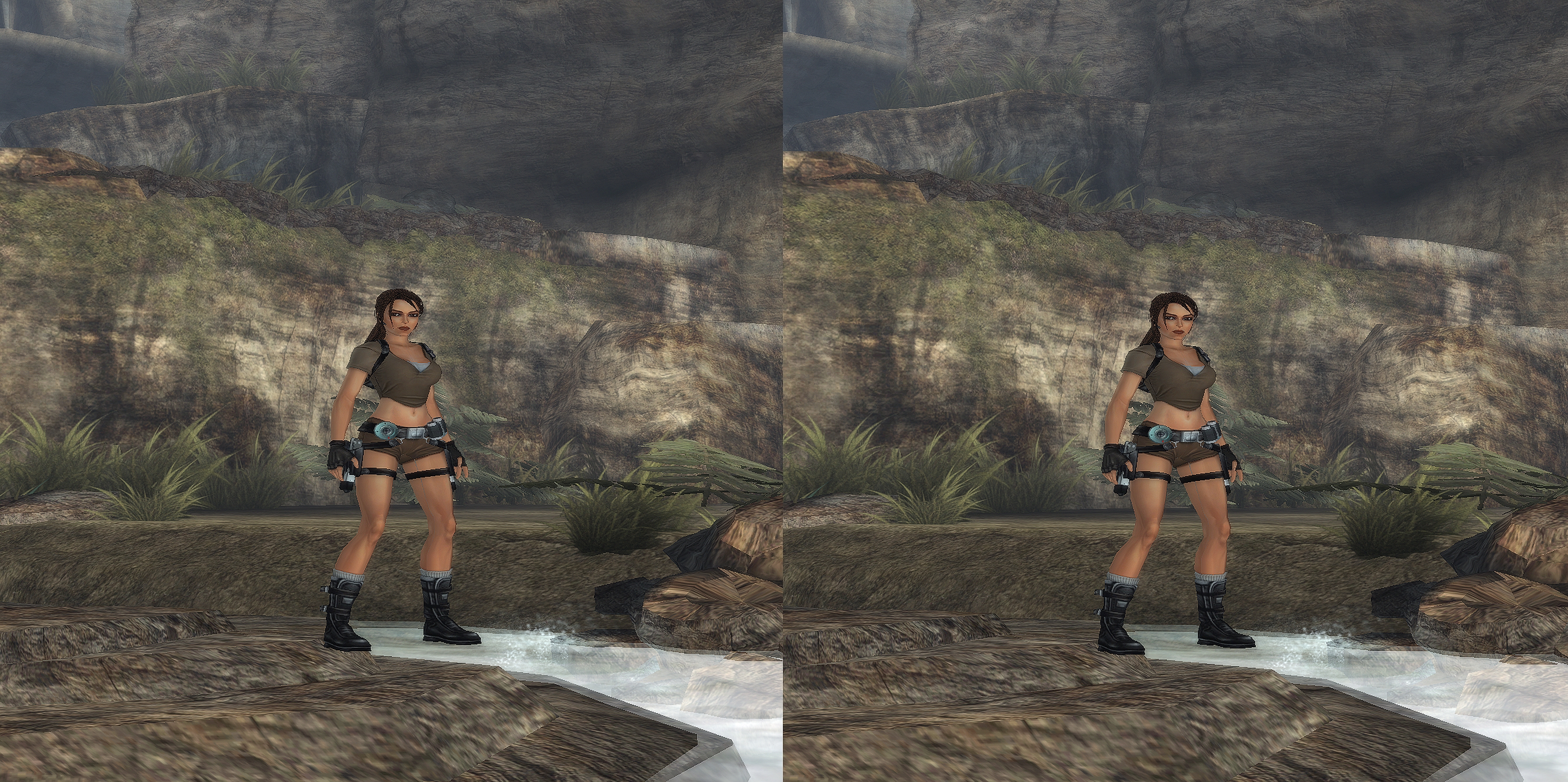 May 20, 2025 at 5:13pm #221426
In reply to: Higher resolutions?
Cless_AurionParticipantBoth images look terrible in your pictures.
Well, they are raw images 2k images downscaled from almost 5000×5000 resolution output.
The UEVR looks worse (since its actually rendering at 4860p), the VorpX one… actually looks better than on the HMD.It can be a profile or configuration problem (maybe the wrong type of 3D, etc.)
It is in all games, in all types, from flat 2D to geo3D and any normal configuration.
Its like if VorpX internal resolution has an arbitrary ceiling it won’t go past for some reason.This is ugly even in 1080p. You shouldn’t be able to notice it on a 1080p monitor
Yeah, the image quality of VorpX is only SLIGHTLY better than on my VivePro… which has SIX times less pixels than my current HMD…
If the image quality is so bad, I guess it’s because you weren’t able to record correctly the output ? In this case I don’t see how we could compare.
I exported the raw output, that way they are comparable, its what its being fed to the HMDs.
I tried to take regular screenshots, but UEVR in 2D mode won’t play ball.Why do you want to use VorpX instead ?
I want to play all my games in VorpX (even the ones that won’t hook and will need to use the desktop viewer!).
I’ve been using VorpX for almost a decade now, and my dream since was “Having 4K-like resolution on an OLED HMD, so I can play all the games in VorpX!” … and its very sad to get finally the HMD that can do it… but now VorpX is the one that is bugging out (or limited in some internal way) :(I’m also a professionnal game developper (and I have advanced 3D modeling, animation and rendering skills too but it doesn’t really matter).
Awesome! A fellow gamedev and artist too to boot then!
I’m a professional indie and AAA game developer specialized in 3D Character creation! Moved to Japan and everything to make my gamedev dreams come true and everything hahaha
If this forum had DM’s I’d definitely send you a couple to chat about it lolThere is no way I can see blurry letters in VorpX.
I know right?
Even the G2 has more resolution than the image I sent! (you can even see the aliasing in the letters!)But as we said, you may be right on a PPD limit. I wouldn’t be able to tell with my current VR headset, which is already better than most.
Nah… far from the PPD limit still (sadly lol, its “only” around 45PPD).
Since you have a G2 it is easy to realize. For every 1 pixel the G2 has, the MeganeX8K has 3.
I’m not even getting to the 24PPD from the G2 in VorpX right now I’d bet :(I never use auto resolution, but most peope do, and as far as I know it limits resolution (it depends on game profiles).
Make sure you disable it if you want to play in very high resolution.
Of course, first thing I checked! I also disabled any sort of AA on both, to make the aliasing more obvious in both images and make comparisons better (very noticeable in the bridge ropes!).
Anyway, with hooked games, if you don’t see any difference between resolutions above 1440p or 2160p (or even 3200p), there is a problem somewhere, because it’s not the usual behavior.
I thought so too! That’s why I tried to reinstall a couple versions.
Reinstalled GPU drivers… and nothing.
The HMD is SteamVR native, so it should be acting just like the Index or any other native SteamVR HMD :/Everytime I tried, UEVR was particularly bad in 2D screen mode (a lot of aliasing and there is no curvature so there are distortions).
Dammit, weird again. That is exactly the opposite experience to what is happening to me.
In UEVR when I put it in 2D mode, not only the FPS boost up massively (due to all the processing that is not being done), but all aliasing instantly disappears (which… to be honest, makes sense, its stretching like a 4000×4000 image on a small square in front of me, instead of stretching it all over my FOV lol)——————————————————————————–
With the extreme resolutions you are mentioning, I think only the virtual monitor can reach, although it might currently be limited to 4860p max in the vorpX app.
That’s the thing. I made sure that in both instances, the game is running in 4860p. (I tried both by launching from the desktop, and the normal way without any differences)
The framerate matches 4860p on VorpX, the computer is using the GPU at an expected level… its just that VorpX isn’t showing the detail for some reason.
There may be be other special cases.
I tried many games, all of them max out at that very specific “VorpX” resolution. So does the desktop viewer (even when the desktop or the games are clearly set at 4860p!)
It’s important to note that you must have these custom resolutions created for a game to be able to recognize and display them. You test and create these in Nvidia Control Panel for your physical monitor, or the vorpX config app for the virtual monitor.
Forgive me if you already knew all this. I only mention this on the chance you are skipping something. like editing a game’s ini resolution without first creating the monitor custom res to match.
It’s the in game selected resolution that matters, not the SteamVR slider.
Nono, please, thank you for taking time to reply at all!
I did try all that. I made sure the games are ACTUALLY rendering at that resolution (checking not just the settings, but also GPU usage and FPS and such).
It really does just feel like there is an arbitrary “ceiling” I can’t pass when using exclusively VorpX :(
My SteamVR resolution is set at roughly 6100×5600, which basically 1.5x the resolution of the MeganeX8K (using up 100% of the panel’s image quality, which makes it equal in pixel density to a 4K 32″ monitor at regular viewing distance).And don’t use the Desktop Viewer (not to be confused with the Virtual Monitor) for games, always better to hook in with vorpX the intended way. Even for 2D play. The viewer is just capturing the desktop, performs worse, and looks pixilated.
Yeah, I tried both, just in case anything changed… and it didn’t :(
May 20, 2025 at 1:22am #221422In reply to: Higher resolutions?
dellrifter22ParticipantWith the extreme resolutions you are mentioning, I think only the virtual monitor can reach, although it might currently be limited to 4860p max in the vorpX app.
Are you turning off your physical monitor when playing? Or rather, does vorpX turn off your monitor? This is how you know the virtual monitor is active.
If your physical monitor is active for playing, you may be limited to its capability.
In my experience, standard 2D games can only be set to render as high as your monitor can accept. In the case of my physical 1440p monitor, 2880p is the highest custom resolution test it can pass and create. Therefore 2880p is the highest in game resolution I can select in game.
If I want to go higher, I must use vorpX’s virtual monitor instead. I use the vorpX app to create and save the custom resolution I want for the virtual monitor, then select that resolution within the game’s settings.
It’s important to note that you must have these custom resolutions created for a game to be able to recognize and display them. You test and create these in Nvidia Control Panel for your physical monitor, or the vorpX config app for the virtual monitor.
Forgive me if you already knew all this. I only mention this on the chance you are skipping something. like editing a game’s ini resolution without first creating the monitor custom res to match.
It’s the in game selected resolution that matters, not the SteamVR slider.
And don’t use the Desktop Viewer (not to be confused with the Virtual Monitor) for games, always better to hook in with vorpX the intended way. Even for 2D play. The viewer is just capturing the desktop, performs worse, and looks pixilated.
May 16, 2025 at 6:46pm #221416In reply to: Higher resolutions?
Cless_AurionParticipantIt’s definitely not better than VorpX. At best it’s different, but image quality can’t even compare because most beautiful settings don’t even work with UEVR.
I see! Maybe it varies a lot between games, because the games that have proper Native Stereo for me… look like the improved version of the monitor version. And I’m a graphics whore, after all, I’m a professional 3D videogame artist.
How do you configure UEVR to get a good image quality and see every details miles around like in VorpX ? Because every person who really tried both around me said me that VorpX has a lot better image quality.
I’m… not sure. I’ve been using VorpX since the early days, even going as far to using the shader authoring tool to create my custom profiles and… Even if its good, its never been flawless as UEVR seems to get to. (although I get way less control in UEVR without actually coding in LUA than with the authoring tool :S)
Well, let’s put an example. If I run Tales of Arise on VorpX, a UE4 game. 3D shadows are borked, due to the common issue with shaders on G3D. On top of that, like I said, it not only runs in a “window” since it isn’t fullVR compatible, but even when put both in that mode, VorpX only goes as high as under 3000p. On UEVR most shaders are flawless, except for the camera FOV that seems a bit weird at times (since it doesn’t zoom in like it would in a 2D screen)… and that’s it. I can run it if I can at 7000p, where pixels are literally so small I can’t tell them apart. A visual clarity that is so ridiculous I can see into the distance (at like… 10fps, of course lol). But even in UEVR “2D window” mode, I can easily put it at 5000p, get 90fps, and flawless image.
Maybe you don’t know how to configure VorpX, or as I said, you are very sensitive to something most people don’t even notice.
Maybe I’m missing something, but I mean, like I said, been using the thing since the early days, and I’m a user advanced enough to make their own profiles with the authoring tool… Tinkering with settings is totally my jam.
I just think not that many people are running HMDs with resolutions of 3550×3880 per eye yet. It would be ideal if Ralf could throw some light into this to be honest! And I mean, many people would notice if a program is rendering at like 2/3 or less resolution the HMD is capable of, I’m sure!Did you try the ClarityFX, Sharpness and Texture Enhancements settings ? (VorpX’s Ingame menu page 2) It’s very impressive on my VR headset if properly configured.
Yes, of course! I mean, it does make things better, but that doesn’t cut it, it really just needs way more resolution.
We probably don’t play the same games. I mostly play AAA games in VR (and anyway most of them aren’t made with Unreal Engine, except Atomic Heart which is an UE4 game and is better in VorpX).
I see! Surely we don’t play similar. To be honest, I like VorpX better as a “3D window” to the world better than full VR immersion. For that I feel UEVR is great, since it basically uses native UE VR rendering pipeline to show stuff.
As far as I know, you can always use max settings with VorpX in AAA games with a good enough resolution. It’s impossible with UEVR (either because it doesn’t even work, or because it works but it’s not optimized enough).
The problem is I straight out can’t. Like I said, is like VorpX just hits a ceiling of resolution the HMD won’t go over, even when I’m trying to force it (be it through the game engine rendering at higher resolutions, or the settings in SteamVR).
As I said, you could not reach such resolutions with most beautiful games (especially with Unreal Engine 4/5 AAA games…)
I mean… I have a heavily overclocked 4090 with a 9950X3D, and tolerance for low FPS, so I can easily play a game at like… 40fps and not feel wrong about it. Even in VR I play with most maxed out always (when it makes sense ofc). I don’t play that many AAA games though, I’m more interested in AA and indie, with the nice AAA here an there.
So It depends on the game, and on your use. Anyway both programs have other pros and cons depending on your expectations.
Yeah! I just seem to choose UEVR for all the UE games.
Hopefully, I am doing something wrong, or there is a fix I didn’t think for this! It really is a shame not being able to use VorpX now that the MeganeX8K is giving me such ridiculously high PPD (it sits at around 46PPD, with mOLED quality, its insane!)
May 12, 2025 at 4:39pm #221401In reply to: Higher resolutions?
Cless_AurionParticipantUEVR’s sharpness & clarity isn’t even close to VorpX at medium/long distance in every AAA game with large outdoors environement I tried
This is SO WEIRD to me.
Because its the literal opposite to me in 100% of the cases.
UEVR is always sharp to perfection (even if my GPU wants to cry at single digit FPS) when I crank up resolution, while no matter how high I put the resolution on any VorpX game… it always looks “terrible” (at around 2000-ish p). Like, I can put the game at literally 8K (4000p), the GPU is clearly doing it, since the game chugs like it wants to die… yet the resolution and jaggies I see are identical to the ones I had when rendering the game at 4k (2160p). That’s the issue for me there. Hopefully that explains it better!Also, to my knowledge… UEVR is best in UE games overall, by a lot. And I mean, its not surprising really, VorpX works on like a bizillion other engines, while that one is specific to UE4-5.
An example of that would be Harvestella. I can run the thing on UEVR at 15000×7500 (yes, 7500p per eye), at around 30-45fps. It uses up every ounce the MeganeX8K’s clarity, literally can’t look better. Then when I try to run it at 8k (7600×4300), it really doesn’t look any different from just playing it at 3860×2160.
So something weird is going on on VorpX that is limiting the resolution it renders at.
The Desktop Viewer itself, looks poor compared to the image that the SteamVR UI window gives too. Maybe running at high 2000p? But basically unusable compared to just using native SteamVR desktop windows…PS. I have around 20/20 vision. With the MeganeX8K you can actually do the optometrist tests and pass them about as well as you would in real life, it is just that dense in pixels. The difference between 2000p and 4000p is about the same that you notice on a 1440p to a 4K display, so its quite noticeable to me.
Feb 4, 2025 at 11:19pm #221100In reply to: Visual Artifacts and Low Image Quality in VorpX
BoblekoboldParticipantI think an RTX 4060 isn’t a very good graphic card to use PC VR with a Quest 3.
Especially if you use a laptop version, which usually are a lot less powerful.
You may not be able to apply my advices. Try lower values (of SS, Bitrate and resolution) first…
You can check Quest 3 image quality with another PC VR program (like SteamVR’s DeoVR with a detailed 4k regular photo/vidéo, not 180/360°, for example ? Or photogrammetry in SteamVR’s Home)
You could also use a more optimized VR headset. But it’s still a laptop with an RTX4060… I had good results with VorpX, a desktop with GTX1080 and a Reverb G2. I was able to play games like Death Stranding, Bioshock Infinite, Bioshock 1, Elden Ring, Guadians of the Galaxy, etc.
Jan 8, 2025 at 1:35am #221034In reply to: Basic Trouble Shooting – Please Read This First!
manobrodaParticipantHello everyone.
I would just like to inform the VorpX team and those interested that there is an incompatibility between Vridge or SteamVR and VorpX.
For native VR games, I use Vridge with my Quest2 via Wi-Fi, and it works very well, e.g. Project Wingman.
For other games, I used VorpX with SteamVR (e.g. Take on Helicopters), and it worked very well. But I stopped using it for a while.
I recently decided to use VorpX to play Ace of Combat 7, but after updating VorpX, I noticed the following problem with Vridge or SteamVR: when I entered games like Project Wingman or Star Wars Squadrons, I could no longer move from the spot. Although I could see everything around me, there was no movement in the other axes, keeping my head fixed in one point.I tried to disable VorpX for these games in the VorpX settings itself, but without success. I even closed all VorpX processes on Windows, but the problem persisted.
To continue playing native VR games, I had to uninstall VorpX, which solved the problem.
But I would like to keep it installed on my PC, so that I can play non-native VR games.Has anyone had a similar problem? Thanks everyone.
Dec 21, 2024 at 5:01pm #220970In reply to: Bioshock 2 (Fixed crash)
RalfKeymasterThanks!
One additional hint: After years of (on and off) searching for some mysterious vorpX bug that only materializes in the original Bioshock 2 and a handful of other 32bit DX9 games, I’m pretty sure I recently found the actual issue while I did some general memory optimizations: too much memory used with vorpX.
For the GOG (not Steam unfortunately) version that can be fixed by making the game ‘large address aware’, which raises the 2GB RAM limit 32bit applications usually have to 3GB. The same fix also works for Dragon Age Origins btw., which has similar random crash issues without being large address aware.
A simple patcher can be found here for example:
https://www.techpowerup.com/forums/threads/large-address-aware.112556/Note that trying this fix only ever makes sense for old 32bit games, newer (64bit) games will never need this.
-
AuthorSearch Results
-
Search Results
-
Topic: [SOLVED] Bad resolution bug
On Crystal Super, any and all settings games and desktop view is low res without clarity maxed it’s completely illegible to make out anything. Somethings bugged and I’ve seen enough similar posts to do with resolution bug or artifacts aliasing just people phrasing the same issue differently and not really getting answers. Just want to confirm these people aren’t making it up.
I can side by side with the stock pymax desktop viewer, steam vr desktop viewer or any other app, something about vorpX is coming out at 20% resolution if that of whatever resolution it’s told to be in games or desktop mode. I don’t pretend to know why but its a reality let me know if you learn a fix for it, unusable as is.
It would be better to set the ‘device selection’ & ‘in game hooking’ on a per game basis.
I have Meta Quest but for ‘Farming Simulator 25″ the ‘device selection’ needs to be set to ‘SteamVR’, which I don’t always remember to do, but for most other games it’s set to ‘Oculus’.
Tomb Raider Legend (Original Renderer) – G3D
This is a shader fix for the Original (NOT NEXT GEN ! ) Renderer. No key tools etc. needed.
– Required: additional files
– May not work with the Steam game (renamed exe required)
– Nice S3D in all modes
– Full VR with Headtracking
– Fixed HUD
– Disable Water Effects !
– Profile available at the cloud