
Archives

Homepage Forums Search Search Results for 'Steam Games'

Viewing 15 results - 31 through 45 (of 1,505 total)
  • Author
    Search Results
  • #222080
    Boblekobold
    Participant

    Great news !
    Did you try with “SteamVR” or “OpenXR” in “Device Selection” ?

    Note you can still use WMR + OpenXR with Windows 11 as long as you don’t update too much (23h2 should be fine).
    It is very optimized and reliable, never freezes, and works with 32 bit games. I don’t know exactly what Oasis can do and if it’s as optimized as WMR but I guess it’s SteamVR only (according to the description, you can use OpenXR, but probably only the SteamVR’s version, so it may not always work as intended, especially with 32 bit games – In this case you’ll probably have to use “SteamVR” option). I may be wrong since I didn’t try yet (I would prefer to keep using WMR but I’m glad we have another option now). Let’s hope it will keep working as long as we need to.

    #221943
    Ralf
    Keymaster

    If you happen to use SteamVR as your OpenXR runtime, configure vorpX to use SteamVR directly instead.

    Valve’s OpenXR implementation is not only outdated (i.e. doesn’t support the latest OpenXR version). It also, spec violation one, has no 32-bit support for older games. And, just as bad, messes up two OpenXR functions, spec violation two, that are used to snychronize frame timing in more complex multithreaded environments, causing severe FPS drops with vorpX compared to working OpenXR implementations or using SteamVR directly.

    They ignore reports from several devs in both regards since several years, so they probably won’t fix any of that.

    TLDR: Valve’s OpenXR objectively sucks. Do not use.

    #221816
    Ralf
    Keymaster

    26/01/13 | vorpX 25.1.5 has been released

    Another maintenance update. Addresses a couple of input glitches, comes with a rewritten host-exit that better handles exit crashes with Meta’s OpenXR since a recent Meta Link update, makes alternative hooking usable for more games, fixes a rare DX9 issue, has a bunch of profile fixes/updates and more.

    Click here for a list of noteworthy changes

    • vorpX: keys wrongly blocked in some DirectInput games (e.g. Fallout 3/NV).
    • vorpX: the tracking center hotkey also ensures foreground and input focus.
    • vorpX: ALT+TAB and back could occasionally confuse key state tracking.
    • vorpX: fixed cursor clipping in some older games (e.g. Metro 2033).
    • vorpX: headset audio device switching did not work anymore.
    • vorpX: D3D9: better unhooked surfaces handling, e.g. Venetica ALT+TAB crash.
    • vorpX: improved host exit, cleaner in various games and with Meta OpenXR.
    • vorpControl: folder exclude handles symlinks (e.g. latest EA Desktop).
    • vorpControl: minimize runtime windows option supports latest Quest Link.
    • vorpControl: alternative hooking working for more games.
    • Cyberpunk 2077: improved sync between mod-portion and vorpX.
    • Tron 2.0: .ini changes weren’t applied anymore since a while.
    • Dishonored 2: scalable HUD added.
    • Dragon Age Origins: deal with GOG version 2-core lock.
    • Dragon Age II: deal with GOG version 2-core lock.
    • Farming Simulator 25: Fixed a Z3D issue related to vehicle mirror count.


    25/12/20 | vorpX 25.1.4 has been released

    This maintenance update mainly focuses on an annoyance affecting mouse/keyboard players in some games that upscale the image to the monitor size. Under certain circumstances that can lead to vorpX’s stereo cursor being shown at a wrong position, making it difficult to hit buttons in menus etc. Various reasons for this super annoying glitch are now covered. The remaining will follow later.

    Apart from that there have been a few more fixes and a new profile for Farming Simulator 2025 with automatic FOV and a scalable HUD.

    Click here for a list of noteworthy changes

    • vorpX: Improved stereo cursor rendering in games that upscale their output.
    • vorpX: Z3D could break in some games after taking off the headset.
    • vorpX: some games could crash with Windows display scaling set to 150/175.
    • vorpX: some games could crash on audio device change (25.1.3 regression)
    • Farming Simulator 2025: new profile with HUD scaling and DirectVR FOV.
    • Farming Simulator 2022: DirectVR FOV update.
    • Fallout 4: DirectVR FOV scan was broken after a game update.


    25/12/16 | vorpX 25.1.3 has been released

    Another maintenance update, mainly addressing various issues and annoyances that came up since 25.1.2. Aside from the fixes there is a subtle improvement in regard to how the game/desktop images are sampled before sending them to the headset. Power users can also configure the sampling method now with expert settings enabled.

    Click here for a list of noteworthy changes

    • vorpX: Battlefield 2 could crash on map load.
    • vorpX: some games could crash on CPUs with more than 12 cores.
    • vorpX: different image sampling methods for screen/FullVR modes.
    • vorpX: image sampling method user selectable (expert setting).
    • vorpX: option to improve FPS in games that limit core count (e.g. Witcher 1 GOG).
    • vorpX: back to OpenXR 1.0 due to outdated runtimes (eg. Valve, Virtual Desktop).
    • vorpX: relaunching games with another graphics API could fail.
    • vorpX: DX9: (rare) 64-bit DX9 games ran at roughly half the supposed FPS on Win11.
    • vorpX: DX9: some FPS lost since quite a while have been reclaimed (eg. Skyrim).
    • vorpX: DX11: Z3D did not work anymore in several games (e.g. COD Black Ops III).
    • vorpX: DX12: fixed an (currently unused) Z3D method that didn’t work at all.
    • vorpControl: hook helper install auto API detection didn’t work anymore.
    • vorpControl: creating desktop shortcuts did not always work anymore.
    • vorpService: fallback for virtual display/desktop viewer not working on some PCs.
    • vorpService: The virtual display didn’t always get disabled on standby as intended.
    • vorpService: Quest Link detection not working anymore after a recent Link update.
    • Just Cause 3: depth buffer detection could fail occasionally.
    • The Witcher 3: DirectVR: camera position was broken, second position added.
    • The Witcher 3: DirectVR: auto EdgePeek for menus, cutscenes etc. didn’t work.
    • Elder Scrolls Online: shader parser to detect future UI changes automatically.
    • F1 2019: restarting with DX11 didn’t work anymore.
    • F1 2020: restarting with DX11 didn’t work anymore.


    25/09/12 | vorpX 25.1.2 has been released

    Another maintenance update with about a dozen noteworthy changes and fixes.

    Click here for all changes

    • Head tracking mouse emulation did not work anymore in desktop viewer.
    • Messages shown in some games on start could become unresponsive.
    • Mod component install with the virtual display failed due to an unclickable prompt.
    • Some games did not exit cleanly since vorpX 25.1.0.
    • Workaround for 32-bit games that use too much RAM on CPUs with many cores.
    • Potential workaround for old games that assign small stack sizes (untested).
    • In games with .ini and mem-scan FOV, ini-controls weren’t shown before scanning.
    • Avoid more annoying virtual monitor related Quest Link self-restarts.
    • Communication between the service and 32-bit vorpControl was broken.
    • The service could use an entire CPU core after lock/unlock, standby/resume etc.
    • Custom sync selection in the vorpX menu selected different options than shown.
    • Trouble shoot data now includes all relevant log files.
    • Better service handling in the installer.
    • Elder Scrolls Online: HUD shaders updated (again).
    • Cyberpunk 2077: mod components updated for CP2077 2.31
    • As always numerous smaller fixes and optimizations.


    25/08/30 | vorpX 25.1.1 has been released

    This maintenance update brings some OpenXR improvements, carves out more precious GPU memory, enhances Quest controller support with SteamVR and fixes a bug where Z3D became heavily pixelated after switching 3D modes.

    Auto-updating from 24.1.0 and 25.1.0 will likely fail (sorry!), you may have to reinstall manually with your web installer. If you didn’t keep it, you can get one here: click

    Click here for all changes

    • GPU memory usage reduction due to headset sync optimizations, ~150 MB at 4K.
    • Auto judder protection when a VR runtime throttles the headset framerate.
    • Rendering the start room could produce glitches/DX errors.
    • DX11/DX12 Z3D could become heavily pixelated/after switching 3D modes.
    • SteamVR: emulated start/back gamepad buttons on Quest controllers now working.
    • OpenXR: deal with outdated OpenXR runtimes (e.g. Valve, WMR)
    • OpenXR: VR controllers were rendered upside down since an OpenXR lib update.
    • OpenXR: resetting the renderer in case of an error could cause a crash.
    • OpenXR: head rotation felt wobbly in immersive screen/cinema mode.
    • OpenXR: don’t use Valve’s broken OpenXR, use SteamVR if set as OpenXR runtime.
    • OpenXR: auto switch to Quest Link or SteamVR if no active OpenXR runtime is set.


    25/08/28 | vorpX 25.1.0 has been released

    This update reunites the regular and the ‘cutting edge’ branches. For those who until now used the regular version it brings three major new features: motion controller gestures, a rewritten desktop viewer and a virtual monitor.

    Those who already used the cutting edge build can skip to the full changelog at the bottom of this post to check what has changed since then.

    Motion Controller Gestures

    You can now map predefined motion controller gestures to key presses and gamepad actions. Aminig down sights, reloading, melee combat, steering wheels and a lot more gestures are available to turn flat games into more immersive VR experiences. While not every game benefits from gestures in the same manner, some (e.g. first person shooter games) can actually feel close to native VR that way. Even seated just a handful of gestures can tremendously improve immersion compared to playing with a gamepad or mouse/keyboard.

    Various profiles already have gestures predefined, try e.g. Cyberpunk 2077, Starfield, Titanfall 2 or Aliens Colonial Marines. More will follow. For other games you can easily define gestures yourself. Be amazed how easy that is and how well it can work. Check the video below for a brief introduction.

    Desktop Viewer Rewrite

    The rewritten desktop viewer now handles high GPU load a lot more stable and also addresses a bunch of annoyances the old desktop viewer had, e.g. the inability to display Windows admin rights prompts.

    If vorpX can’t hook a game, try the new desktop viewer. Especially in tandem with the third new feature the vorpX desktop viewer now is the ultimate VR flat game cinema.

    Virtual Monitor

    The new virtual monitor finally makes running games at higher resolution than your actual monitor allows a breeze. All important resolutions are predefined, and you can easily add more if you want in the config app.

    Added benefit for desktop capturing and playing games unhooked with the desktop viewer: the virtual monitor always runs at the refresh rate of your headset, which removes any form of micro stutter that normally is the result of capturing e.g. a 60Hz monitor and displaying it on a 90Hz headset.

    The easiest way of using the virtual monitor is launching the vorpX desktop viewer and putting on your headset. Per default vorpX will then switch to its virtual monitor.

    Full Changelog

    Biggest changes from official (21.3.5) to last cutting edge build (24.1.0)

    • Motion Controller gestures that easily let you map VR controller gestures to key/button presses. vorpX gaming as close to native VR as never before.
    • A virtual monitor has been added that lets you play games at arbitrarily high resolutions and always has the exact same refresh rate as your headset, which is especially great in cunjunction with the desktop viewer. The smoothest VR desktop experience ever.
    • Desktop viewer rewritten to minimize CPU/GPU usage, get rid of a few annoyances, and work great with the new virtual monitor.

    Biggest changes since 24.1.0

    • Redesigned rendering/post-fx pipeline that significantly reduces the amount of GPU memory used by vorpX at high resolutions.
    • Custom memory manager that keeps memory allocated by vorpX separated from game memory as much as possible. Improves general stability everywhere, most notably when using high resolutions with some 32-bit games, e.g. Dragon Age Origins, Venetica.
    • Special treatment for 32-bit games able to handle more RAM than the usual 32-bit 2GB limit. vorpX can now detect and directly utilize the extra memory. If you encounter crashes with 32-bit games at high resolutions, check the internet for tools that make them ‘large address aware’. Note that trying that with modern 64-bit games has no effect, those can use all your RAM per default.
    • Major (ongoing) spring cleaning continued: lots of internal changes and refactorings that improve general stability and/or help keeping the developer of this Tower of Babel happy.

    Noteworthy smaller changes/fixes since 24.1.0

    • Optimized texture sharing between game and vorpX threads. Fixes DX12 black screen caused by nVidia driver 580.88+ and in general may/should be a bit smoother under high GPU load.
    • Improved cursor tracking. Fixes cursor flicker e.g. in AC:Valhalla/Odyssey.
    • Cinema mode uses reduced lightmap sizes in 32-bit games that aren’t large address aware to squeeze out some extra GPU RAM for higher resolutions.
    • DX9: Some rarely/never encountered StateBlock related stuff handled. Just in case.
    • DX9: Hooking related changes that may improve hooking reliability in some cases.
    • DX9: Generic 3D/Headset modes did not work on some AMD GPUs
    • DX9: Fixed an issue that could cause games to hang on device creation.
    • DX9: Fixed an issue that could cause games to crash on display mode change.
    • DX9: Fixed an issue that could cause games to crash on load (e.g. GTA IV).
    • DX9: Fixed an issue that could cause games to hang fullscreen (e.g. Splinter Cell 3).
    • DX9: The start scene had some weird render glitches in ‘Generic VR headset’ mode.
    • DX10: Potential exception on init (e.g. Crysis DX10)
    • DX11: Support some rarely used DX11 features (e.g. WoW non-legacy DX11)
    • DX11: Improved G3D performance, up to 300%! Don’t get too excited though, that is an outlier. Usually expect anything from 0%-15%.
    • DX11: More efficient multithreading. Improves FPS in some games (e.g. Elex 2).
    • DX11: Image was garbled in some games, e.g. ArmaA III (24.1.0 regression).
    • DX11/12: Optimized shader bookkeeping. Can save >200 MB of RAM (e.g. HZD).
    • DX12: More efficient resource bookkeeping. Up to 20% better FPS (e.g. Uncharted 4).
    • DX12: Fix for hiccups/uneven FPS in some games (e.g. The Last of Us/Uncharted 4).
    • DX12: display mode switching/window resizing failed for some games (e.g. Far Cry 6)
    • DX12: various authoring hotkeys did not work.
    • Tracking: The jump/crouch detection didn’t work correctly anymore.
    • vorpX control: App could crash on startup (24.1.0 regression).
    • vorpX control: App could crash after installing hook helpers.
    • vorpX control: App could hang after running for a while.

    Game Profile Changes/Fixes since 24.1.0

    • Cyberpunk 2077: support for latest game version.
    • Dark Souls III: scalable HUD didn’t work under some circumstances.
    • The Elder Scrolls Online: shader fixes for latest game version.
    • The Witcher 3: The profile’s mod part could activate itself without vorpX running.
    • World of WarCraft did not work anymore after removal of the old D3D11 renderer.
    • Abzu: ini changes were applied on each launch instead of just once.
    • Hellblade: ini changes were applied on each launch instead of just once.
    • Observer: ini changes were applied on each launch instead of just once.
    • Prey (2006): resolution wasn’t set as intended due to a typo.
    • Conarium: improved DirectVR memory apply on/off check
    • Deus Ex: Human Revolution: various fixes.
    • The Surge: motion blur hint added.
    • Morrowind: MGE shader chain could become unavailable.
    • dgVoodoo2: shader parser for versions 2.7+
    #221803
    Nukeboyt
    Participant

    I am having one heck of a time getting this to run. Fixed the Nvidia driver issue (thanks). Can get it to run on my Quest only via Steam Link with Valve Index selected in Config. When I choose Quest and run game via Quest Link, it errors out saying it cannot detect Quest Headset, Same for if I choose OpenXR and run via Quest Link or Virtual Desktop. Any help suggestions would be appreciated! All other games from Meta Link or Virtual Desktop launch just fine. I must be doing something wrong. Edit: I sent several of the crash reports withing an hour or so prior to this message (≈ 1400 CDT)

    abeardedpirate
    Participant

    Have a PSVR 2. Installed the free mod to see what this is about.
    In settings selected SteamVR since PSVR is using SteamVR app.
    Launch game. SteamVR never brings up the game. Can see game if going to desktop mode or theater mode.
    While game is open no inputs work. No keyboard inputs, no gamepad inputs, no inputs from my PSVR2 controllers.

    I have uninstalled the mod, the game, fresh reboot, installed the game, rebooted, installed the free mod, fresh rebooted again and everything in between. The game will never register inputs. My keyboard does work as I can press Windows Key and get the start menu up to do other things. I can also hit the PS home key to bring up steam interface so I know my buttons work but they are not registering with Cyberpunk itself.

    I uninstalled the mod and selected default on every setting inside of cyberpunk 2077 before rebooting and reinstalling the mod just to make sure everything is good. Since there is 0 interface with the free mod the only way I can get the VR selector up (Steam / Meta / Other) is to just reinstall the mod again.

    I’ve launched Cyberpunk 2077 letting it open Steam VR and I’ve launched Steam VR and then opened Cyberpunk with no luck.

    I went on Steam settings and have enabled steam input override for Cyberpunk 2077. I’ve tried it disabled and enabled same issue both ways.

    I’m on an i9900k with a 2080ti with the PSVR2 plugged directly into my 2080ti. I haven’t had issues with other actual VR games/programs but I can’t make this work. Nothing seems to do anything. Delete / left button + right button / and L3 or w/e gamepad is nothing brings up any settings like the mod installer says it does.

    Any help would be appreciated cause I feel like I’ve exhausted all the troubleshooting steps I’ve seen on this forum at this point.

    #221763

    In reply to: Nvidia driver 580.88

    Ralf
    Keymaster

    Frankly I can’t even really imagine how a driver update could cause such an issue. vorpX captures the game output before it is sent to the driver and sending the final image to the headset later works through the VR APIs (Meta/SteamVR/OpenXR) like in any other VR app. Not a single point in that pipeline touches the graphics driver directly. Very, very weird.

    Either way, since for me 580.88 works fine, so that I can’t replicate your issue, all I can recommend is:

    1. Trying all three VR APIs in the config app, a Quest should work with all of them.
    2. Using a driver version that is working for you.
    3. In case this is related to a gaming laptop, try to disable the integrated GPU to ensure that games run on the same GPU that the headset is connected to, which usually is the dedicated GPU in a gaming laptop.

    If you want, you can create a trouble shoot archive with log files and system infos in the config app and send it to support at vorpx com. Probably won’t show anything useful, but can’t hurt to look at it.

    #221727
    Boblekobold
    Participant

    Parenthesis : Even without any bug, I don’t think it’s possible to use full potential of a 8k VR headset (especially with SteamVR). It’s probably not useful to most people anyway.

    There are a lot of recent games which are a lot more detailed and beautiful in 3840p (5120×3840) than 3200p with VorpX on my G2, even if it’s a 2160p VR headset. It’s probably because the details you can display with a 2160p VR headset in certain games aren’t computed without supersampling (at 3840p, I never tried more).

    I may be wrong, but this kind of 8k VR headset are great to get “perfect” PPD if you have a perfect sight, but only with very old (or not demanding at all) games.

    In my opinion, most old games, even beautiful ones, are already great in 2880p (in my G2) because there is a limit due to the textures of the games. You can already perfectly see the defaults of the game itself, even if VorpX enhances graphics a lot. I only used 3200 and 3840p with very detailed games like Metro Exodus, Atomic Heart, etc.

    Considering 8k VR headset may be more demanding than a Reverb G2 (WMR/OpenXR/2160p), it could require a better graphic card than my RTX4090 to achieve the same result in some cases.

    I think a 2880p VR headset like Pimax Crystal Light has already too much resolution in most cases. Some youtubers with RTX4090 seems to prefer G2 over Crystal Light on a same game, even to use UEVR, for example. There must be a reason.

    Note : a VR headset with higher FOV may require more resolution to achieve the same result so it has to be taken in consideration here.

    #221717
    Ralf
    Keymaster

    Sounds as if the game switches back to a lower res, which would be super weird. Never heard of anything like that before. Try to add a custom res in the nVidia control panel and then switch your desktop res to that res before launching the game. Some games limit their resolution to the current desktop res. A step-by-step guide for adding custom resolutins can be found in the vorpX help.

    Running a game windowed may also help (again provided it doesn’t limit its window size to the desktop res).

    If you want to use the full potential of your new Pimax headset you must run games at resolutions at or above 4K, i.e. 2160p or more. Roughly 3000p is what your Pimax Super wants as an input res with default SteamVR settings. Might be too much performance wise in modern games though.

    If things still look pixelated when running a game at such high resolutions, there has to be something weird going on after vorpX sends the image to SteamVR, e.g. in the Pimax app or on the headset itself.

    #221701
    Ralf
    Keymaster

    Please make sure to reset any SteamVR settings to default, same with the Pimax software. In the last “low resolution” post here in the end it turned out that the OP wasn’t able to go beyond 3000p. Even if you want to call that an issue, it’s probably a lot more than you are running your desktop with. So there has to be something else going on with your setup. vorpX captures the desktop at the res it is running at, same for games.

    Aside from resetting everything to default: In case Pimax in the meantime has developed an OpenXR driver that doesn’t just use SteamVR’s OpenXR wrapper, switching to OpenXR instead of SteamVR in the vorpX config app might also be worth a shot.

    #221696
    Goph
    Participant

    On Crystal Super, any and all settings games and desktop view is low res without clarity maxed it’s completely illegible to make out anything. Somethings bugged and I’ve seen enough similar posts to do with resolution bug or artifacts aliasing just people phrasing the same issue differently and not really getting answers. Just want to confirm these people aren’t making it up.

    I can side by side with the stock pymax desktop viewer, steam vr desktop viewer or any other app, something about vorpX is coming out at 20% resolution if that of whatever resolution it’s told to be in games or desktop mode. I don’t pretend to know why but its a reality let me know if you learn a fix for it, unusable as is.

    Cless_Aurion
    Participant

    Thanks again for your time replying. I really appreciate you taking this issue seriously.

    Simply sending the res to the headset that you dial in in SteamVR no matter what the actual game res is doesn’t make sense.

    Yes, I know. I’m just saying it so I could try and force the resolution manually, instead of having an arbitrarily “double the vertical resolution” setting.
    I do that with BigsScreen for example. Even when watching a 1080p movie, or playing some old flat game, I will run native resolution (5500p), even if it is to get the dark environment or the screen borders to have 0 aliasing.

    Like said above, you have to look elsewhere to pinpoint your issue. There is no such thing as a “2160p wall” in vorpX.

    I am aware, that is the tragic part. Unless its something driver or hardware/HMD specific, I can’t pinpoint anywhere else since there are 0 issues elsewhere, its only VorpX failing me (which to be honest, its the magic software that made me go and spend $2k on a new HMD at all) :S
    If I had another high resolution HMD over 3000p around, I would test it there, but I only have my VP1 that is 1600p, which won’t do.

    The issues other people with higher than 3000×3000 per eye HMDs (mostly Pimax users) seem to match closely my experience as well, so I suspect everyone with high resolution HMDs has this issue. As more and more high resolution HMDs come in, this issue seems like it will become more and more prevalent.

    A game rendered at 1080p doesn’t look better just because you copy it to a 5500p texture before sending it to the headset obviously.

    We agree in that of course. As long as the image is wrapped around your head or, the resolution of your HMD has a higher PPD than the screen in front you with the game, it should make barely any difference.

    The problem here is… we are DEFINITELY copying a 4860p game image into a 3000p texture before sending it to the headset.
    Not only that, but because I am watching that using the floating VorpX display, now we are rendering what is visible in my FOV of a downscaled 4860p game image at 3000p.
    So, we are squishing that 4860p image into around 2000p in front of my eyes. That’s why aliasing is so aggravating.

    That is also why when I lean in, I can see way more detail that I couldn’t see before
    Also, just in case, yes VRAM bumps up as it should as I scale up resolution over 2160p (in fact, BG3 at 4860p is almost maxing out my 24GB of VRAM, which is about double what it consumes at 2160p).

    Your “2160p wall” sounds suspiciously as if the game actually runs at your monitor’s res although you think it doesn’t.

    Indeed, I thought that too, and it might be the root cause of this issue. If I had a lower(or higher) resolution monitor I would try that theory by plugging only that other monitor in, but I sadly can’t.

    The best way I could control for that on the tests I already did was:
    1. Start VorpX (virtual display gets enabled)
    2. Set Virtual display resolution to 4860p.
    3. Start SteamVR and disconnect all my 2160p displays so only VorpX’s Virtual display is enabled.
    4. Start the game making sure that the only display windows (and the game) detects is VorpX’s 4860p monitor.
    5. Change the resolution of the game to 4860p and restart (or make sure the resolution is already at 4860p or any other higher number than 2160p).

    To deal with such potential issues, either run games windowed or (assuming you already have set up a high enough custom resolution), try setting your desktop res to it before launching the game.

    I already did that, of course. In fact, all the tests I ran I did try in windowed mode first. Then after it didn’t work, I started to experiment and tried fullscreen and borderless modes without any success (which kind of makes sense).

    If a game actually runs at 5500p, vorpX creates a 5500p headset render target. You wouldn’t even be able to let it create something smaller than that even if you wanted when the image vorpX receives is actally a 5500p image.

    I’m 100% sure that is not happening in my computer though. The games and the image VorpX is receiving, are higher than 3000p. This is the core of the issue, which you in your own tests proved that VorpX IS able to pull off (that’s why I said it infuriated me!). Because again, the game window inside VorpX HAS 4860p of detail in it.
    -VRAM reading matches 4860p
    -Performance matches 4860p
    -Visually checking the image by leaning in confirms its 4860p.
    And yet… the actual HMD is only rendering at that fixed maxed 2781×3072 resolution, so its absolutely ignoring that headset render target if its being sent. :S

    Maybe this is a Virtual Display/Windows issue?
    I’m going to try to create a virtual display through other means, and use that instead of the VorpX one, I’ll report back once I do so, but I don’t have much faith in it either.

    In any case, I’m almost convinced that if we don’t solve this here… as the next wave of HMDs come in and we start getting over 3000p resolution, people will start complaining, since right now its only affecting high tier HMDs.

    Cless_Aurion
    Participant

    Sorry for the late reply, crazy busy weeks! I’ve been testing thoroughly to give you as much information as possible.

    Thanks for taking the time to check on this issue, I really appreciate it!
    Damn, it working on your side almost makes it more infuriating.
    I’m very hopeful we will be able to figure it out though, it would make my year!

    For this, I hope FPSVR’s “detect resolution” will work good enough.
    Its results seem to match my visual experience accurately (visual and performance wise).

    >> Might be the game not actually running at the desired res,
    Definitely not, made exhaustively sure this isn’t the case.

    >> might be your headset’s software doing weird stuff or whatever.
    This might be a cause for it, its an obscure HMD, but it would be an issue exclusive to VorpX then, since no other game, or even UEVR are affected by it at all.
    This HMD has 2 different drivers for the HMD. The official one by the makers of the HMD, which is their custom non-SteamVR non-OpenXR drivers. And another one (the one I use most), that is a written from the ground up custom driver that turns the HMD into a native SteamVR HMD. Testing by alternating both drivers shows no difference in VorpX behavior.

    I followed your instructions the best I could. Starting slow and steady.

    Ridiculously low resolutions (like 720p), seem to make it worse since the HMD will run at that, double 720p. The problems start always when I try to go over 2160p. It just won’t happen.

    All games running with no upscaler shenanigans, or AI enhancement of any sort, or supersampling like you asked.
    Using only as a monitor, the virtual one VorpX creates running at 8640×4860. (I tested also with my regular 4K monitor, resolutions there won’t go over 2160p, so not much point to it).

    After playing around, this is the info I can give you:

    HMD’s panel resolution per eye: 3552×3840
    SteamVR Settings resolution:
    3572×3816 (100%) — (Also tried other %, 50% and 200%, with 0 changes to VorpX behavior)
    Advanced Supersample Filtering (OFF) (Also tried ON, nothing will change)

    Not running anything, compositor resolution: 5356×5724 (looks nice and clean)
    Running games:
    -Baldurs gate 3:

    1080p = 1809×2000
    Aliasing is horrible. If I play the game flat in BigScreen (which keeps the 5356×5724 resolution for the HMD) the game becomes WAY more playable, its just like playing on a low resolution 1080p display, especially most aliasing on text disappears. (No awesome VorpX 3D effects there, of course :( )

    1440p = 2344×2592
    Improvement, but far from ideal

    2160p = 2781×3072
    This seems to be the limit I keep hitting.

    Every resolution over 2160p (4860p included) = 2781×3072

    Worst part about this is, like I said, the game is ACTUALLY rendering at those resolutions, I can easily tell by eye by getting closer to the floating screen and new detail will show up, but also, because the framerates match the performance expected and, in BG3’s case, putting the mouse over the window on the taskbar, will clearly state the resolution to the right of the title of the game.

    This applies to all games I tested. Just for the sake of testing, I tried resolutions in windowed, fullscreen with no luck whatsoever.

    TLDR: no matter what resolution the game runs at, the HMD always runs against the 2160p wall. I wish VorpX could just… render at SteamVR’s resolution always or, just not mess around with the HMD’s resolution at all, I’d gladly pay the performance cost. Would that be a possibility?

    Extra data that might be useful:
    -For a render resolution 1:1 sample per panel pixel, resolution should be around 5081×5612 (209%), so definitely we aren’t failing on that side of things, in fact, when I open SteamVR’s menu it is perfectly sharp, since it IS running at the 5356×5724 even when VorpX is running at lower resolutions underneath it (usually 2781×3072)

    -Also, SteamVR wants to default the HMD to 150% (4372×4672).

    Cless_Aurion
    Participant

    Hello Ralf, thank you so much for taking the time to reply from your busy schedule! I really appreciate it.

    So, it seems there might be an issue detecting what is the the max height of the image VorpX sends to the headset, since its DEFINITELY short from double the game resolution.

    It falls so short, that I see clearly LOTS of aliasing everywhere (even the window border). I will go so far to say, that the image quality is not THAT FAR off my VivePro’s when supersampling… while having literally 6 times more pixels, and rendering about 4 times more pixels.
    When I lean into the floating window, I can see all the extra detail I was missing that the game was actually rendering, which suggests the image the game is rendering is way higher resolution than the image the HMD is receiving.

    (Again, for clarity’s sake, the sweetspot of my HMD should be able to catch around 5500p worth of resolution (45PPD).
    Rendering at 4860p, although a high resolution, when on a big screen spanning most of my view, it should still NOT be supersampling, since it fails to get to 1:1)
    (As a note, the resolution of the HMD is 3552×3880 per eye)

    Could it be that Custom Resolutions on vorpX virtual monitor, are not working as they are intended and sending a lower resolution due to the huge numbers?

    I’ve gone as far as to literally unplug both my monitors and exclusively use VorpX’s virtual monitor set at the game’s resolution, 4860p, to no avail. (I’ve tried multiple games that use different engines, all have the same exact issue).

    For extra info, I’m also using a SteamVR native HMD, so I’m guessing there should be no compositor shenanigans going on… (and just in case tried with the inhouse compositor the HMD also has, which changes nothing).

    I’m not even trying to mess with 3D or VR modes yet to remove variables (although I’ve tried with the same issues, in fact, aliasing usually becomes even more glaring and worse when activating them).

    I have also tried launching from VorpX Desktop (which also isn’t really usable due to low resolution of the HMD (not the desktop)) with no luck whatsoever.

    I did also test older VorpX versions, just in case. No luck either.

    I hope this info-dump helps you in some way to figure out the issue. If you need anything else, I will gladly try to help to get this resolved! I really hope the issue isn’t on my side, but with so many HMDs and so many variables… you never know.
    I tried with 2 different (similarly spec PCs), since I did upgrade the whole system, but both had this same issue.

    TLDR:
    I tried all that and sadly it doesn’t work :(

    Maybe there is an issue with detecting what is the the max height of the image VorpX sends to the headset when resolutions per eye are so ridiculously high?

    duke54
    Participant

    It would be better to set the ‘device selection’ & ‘in game hooking’ on a per game basis.

    I have Meta Quest but for ‘Farming Simulator 25″ the ‘device selection’ needs to be set to ‘SteamVR’, which I don’t always remember to do, but for most other games it’s set to ‘Oculus’.

    #221476
    RJK_
    Participant

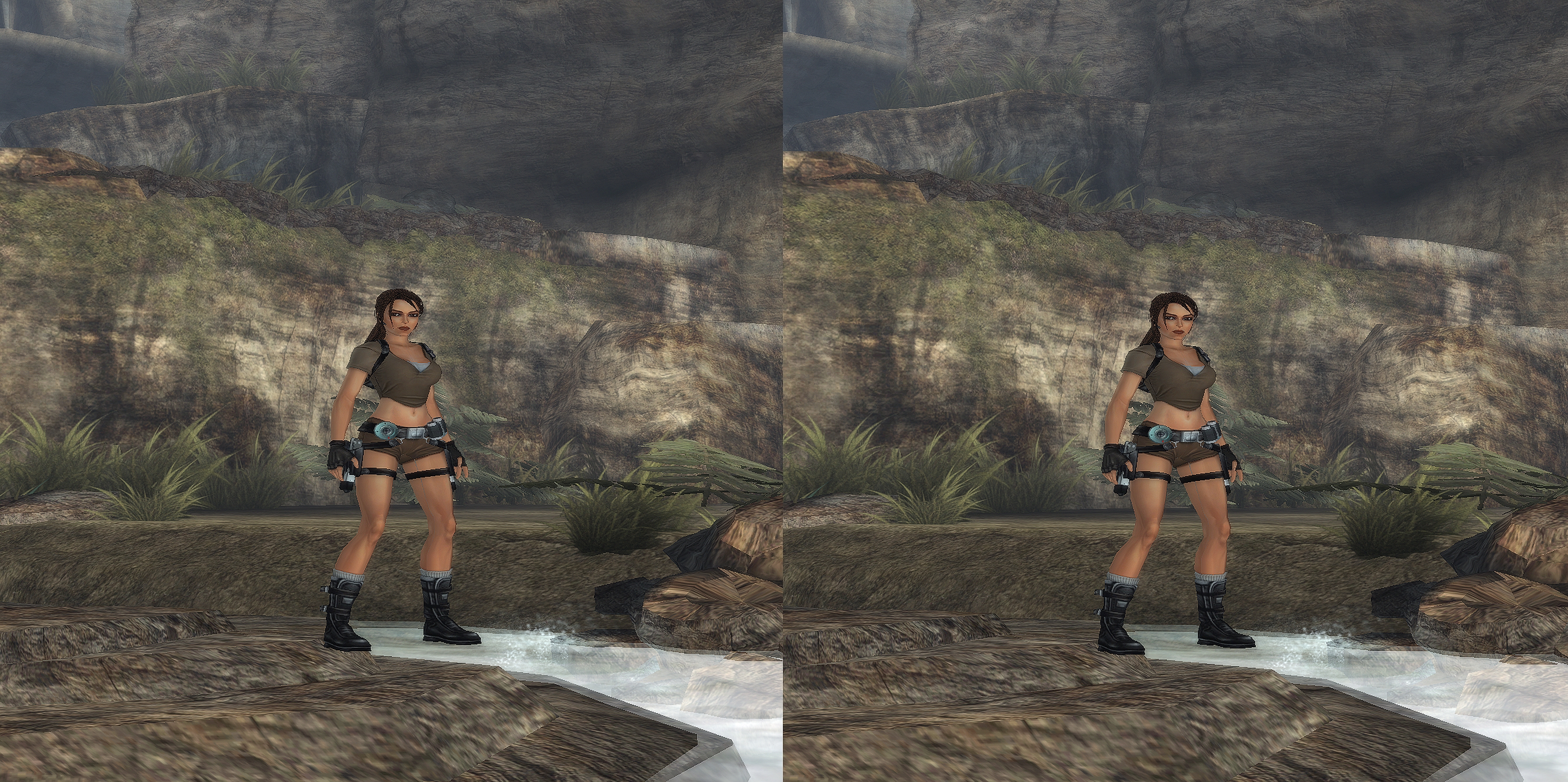
    Tomb Raider Legend (Original Renderer) – G3D

    This is a shader fix for the Original (NOT NEXT GEN ! ) Renderer. No key tools etc. needed.

    – Required: additional files
    – May not work with the Steam game (renamed exe required)
    – Nice S3D in all modes
    – Full VR with Headtracking
    – Fixed HUD
    – Disable Water Effects !
    – Profile available at the cloud

Viewing 15 results - 31 through 45 (of 1,505 total)

Spread the word. Share this post!